INTRODUCTION:
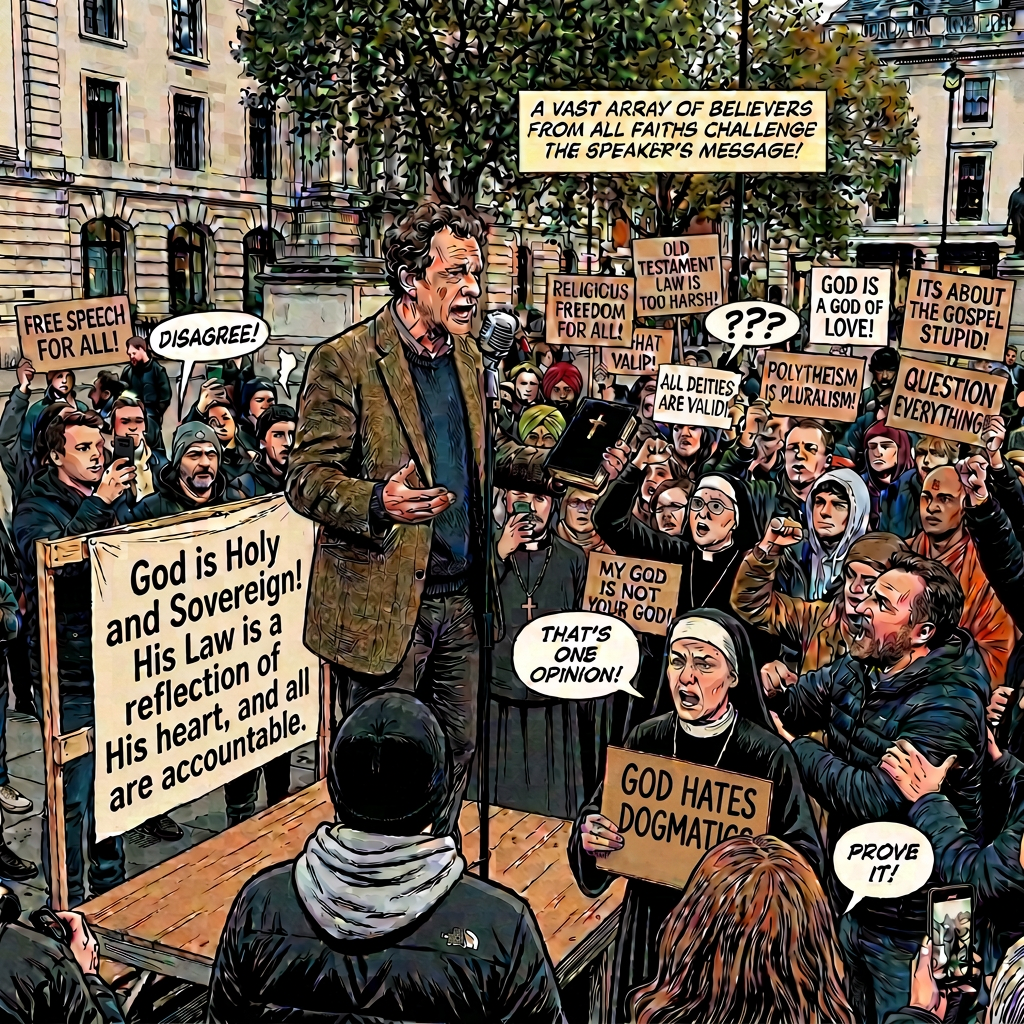
What is the role of civil government? What is the role of God’s Law (theonomy) in it? It depends on who you are asking. Opinions will vary, as they often do with a variety of subjects. And, with those opinions pearl clutching1 is a premium.
In my last post, Viewing Life Through the Lens of Scripture: Progressive Revelation, I dealt with an unasked question in terms of biblical revelation. All of Scripture is important, there is no denying that truth. Paul explained to Timothy that “All Scripture is God-breathed, and useful… so that the man of God is fully equipped.” (2 Tim. 3:16-17). But Biblical truth is progressive. Not progressive like the liberals of today. I’m not talking about having a pluralistic/polytheistic standard of right and wrong. When I speak of Biblical truth being progressive, I mean in terms of how much information (knowledge2) God gives and how and when to apply that knowledge (wisdom3).
The light of truth is not given all at once, but over time it deepens, broadens, and expands in meaning. It reaches a fullness that it did not have when it was new. Thus, Adam was given a little bit of revelation, and then Noah was given a little more, and then the generation of Moses was given more, until the time of Christ where the secrets of the kingdom were revealed, and the apostles of our Lord further developed the knowledge and wisdom of Christ unto great depths.
“…in whom are hidden all the treasures of wisdom and knowledge” (Col. 2:3; NASB).4
Accountable but not Authorized: The Underlying Assumption or Pronounced Claim
One of the things that theonomy gets wrong is biblical justice. All of mankind might be accountable to God for violating His law, but civil governments of all stripes are not authorized to punish pagans for doing so. Why? Well, because we aren’t Israel. Ancient Israel was under a different covenant. They were under the Mosaic Law-Code. Post Christ, things are different on this side of history. How so?
This is what the pod-casters at Defend and Confirm suppose. It is also a common vein of thought by many modern day Christians. It is where an argument is often presented that states that the Church is about grace and forgiveness, not about law and justice. One classic example that I have seen presented on more than one occasion is in reference to 1 Corinthians 5.
In 1 Corinthians 5 a young man is committing an egregious sinful act. He is committing incest and is doing something that Paul admits was known to be wrong even in sinful circles where the name of God is not mentioned, let alone honored (1 Cor. 5:1) . What does Paul tell the Christians to do to the man who is sleeping with his father’s wife (i.e., stepmother)? He says to cut him off from fellowship, using an analogy of leaven—remove that lump from yourselves so that you might be whole, lest the whole lump become infected (i.e., guilty of sin and likewise corrupted; cf. ). The unrepentant sinner is to be treated as a sinner.
“I have decided to deliver such a one to Satan for the destruction of the flesh, so that his spirit may be saved in the day of the Lord Jesus. Your boasting is not good. Do you not know that a little leaven leavens the whole lump of dough? Clean out the old leaven so that you may be a new lump…” (1 Cor. 5:5-6).
In other words, “Corinthians… You who call Christ Jesus Lord… ‘You [should have] mourned instead, so that the one who had done this deed would be removed from your midst’” (1 Cor. 5:2; italicized portion Scripture with bracket added for clarity of thought).
In plain language, they are being instructed to identify the sinner and having confronted him remove him from fellowship. This was to be done in terms of two-fold authority: Apostolic and members of the church community. Both of which are to be done in Christ’s name (cf. 1 Cor. 5:4). Bear in mind that what Paul is instructing the Christians in Corinth to do is in line with what Jesus taught. If a person is found in sin and they will not listen to their brother (his warning/rebuke), or their brother’s witnesses (fellow elders), if they still refuse even after it has been brought before the assembly of God (rest of the congregation), then they are to treat that unrepentant professing believer as a publican and a sinner (Matt. 18:15-18).
As noted earlier, this passage is often cited as a proof text to deny that civil magistrates have a right to punish sinners for their crimes. They say that adultery is punishable by death in the older Testament; under the Mosaic Law-Code. But the Christians in Corinth, under the guidance of the apostle Paul, did not kill the man they merely excommunicated him from fellowship. This was done in the hope that a day might arise when he would wake up from his stupor, repent, and be saved from the fiery judgment he was heading towards (1 Cor. 5:5). In that day, it was hoped he would be returned to them as a brother in Christ.
Categorical Confusion….
Sounds very pleasant doesn’t it. Sounds graceful. Sounds merciful. Sounds like something that Christians ought to give a hardy Amen(!) to. And rightfully so. For our desire when we find one of our members living in sin is to save them from the fire (Jude 1:23). To deliver them from the path of death that they are walking down. Our desire, from a brotherly or pastoral sense, is that they will stop what they are doing and repent wholeheartedly unto the Lord who offered His life as an atonement for our sin.
The problem, however, is a failure to recognize categorical distinctions. This is why some Christians will assume that this passage offers affirmative proof that nullifies the civil response. But not all forms of government are the same. There are different categories of governance, even though all such authorities are derived from God our Lord (cf. Rom. 13:1). There is a distinction between each form of government and their role in terms of action. An offense in the home is not treated in the same way as the offense in the Church, or for that matter in the civil sphere. Just as failure to obey has different forms of punishment in the other institutions we participate in public life. It is a failure on the part of such an individual (or group) to make proper category distinctions (1 Tim. 1:7).
Reviewing Paul’s Assessment in Corinth…
Of course, the apostle Paul would instruct the 1st century Christian in Corinth in this way. They were not a civil governing body. Instead, they were an ecclesiastical governing body. Ecclesiastical authorities—elders and the congregation as a whole, as in this case—could punish the man for his unrepentant sin, but only with the means (authority) that God had given them. They could cut him off, cast him aside, or turn him away from fellowship excommunicating him. This is the exercise of the key bearer. It is a form of death, but not the physical cessation of life. Only the civil magistrate has the authority of the sword, for they are the sword-bearer. They are authorized by God to execute certain kinds of criminals for their societal sins, a different form of death (separation from the physical body, rather than the spiritual body of Christ), but they have no authority to exercise the sword for spiritual sins in the church.
One of the big problems that Christians face when they consider the Law-Word of God is how to distinguish between categories. No one person has absolute authority, except Jesus Christ. All other authorities on this earth are legitimate authorities, but they are limited in the exercise of their authority. Christ’s authority, His dominion, and the extent of His domain has no end. He has been given authority—ALL authority—in heaven and on earth (Matt. 28:18), for His government is all encompassing. Delegated authorities cannot boast such parameters either in terms of dominion or domain.
Paul told the Corinthian Church the correct way to handle the situation before them. It was a public sin. It was common knowledge. No argument from grace could cover it up. It had to be dealt with; immediately and with finality. There were some who were bragging about it. That sin was infecting the church body with corrupting influence. The young man in question needed to “feel” the weight of his sin, for hearing it alone seemed to carry little weight in his mind and the mind of some others. And the congregation needed to fear the warning present in the punishment of that man (cf. Deut. 21:21).
But to execute a man for such things—even things worthy of death—is not within the purview of a church body: local, a full synod, or an entire denomination. Moreover, only one who is unskilled in the Law of God would argue otherwise. For although the type of sin that young man was committing was worthy of death, it could only be executed (the penal code) on the grounds of two to three witnesses. And that had to be tried in a court of law (civil sphere of governance). Meaning that there had to be proof and that man would have to be convicted first in a court setting before the penal code (death penalty) could be exercised.
If that man had been brought before the civil court (either in Corinth or the Roman Empire) , then the case could be tried. But if no one pressed charges (to use our language today), then more than likely he would never have to fear the death penalty until he faced God in final judgment. This is especially true if the law of the land does not deal with the crime appropriately in terms of righteous standards. Without a law laying out the moral code of conduct for the citizens under its dominion, it is impossible to rightly try and convict someone for evil doing.
Difficulty facing the Church…
One of the problems that I see with the handling of the issue regarding theonomy as a whole in terms of justice is the failure to properly discern between category distinctions which are found in God’s Word. The apostle Paul warns Timothy that there are those who try to teach from the law, but they don’t know what they are talking about (see: 1 Tim. 1:7). They were to be identified by elders and even normal Christians, and not listened to. No regard was to be given to their instruction because it was fruitless and false in terms of righteousness, even though it has the appearance of religious thought (e.g., Col. 2:23).5 Jesus taught a similar thing when He said in Matthew 5:19 that if someone teaches God’s children to not obey all the commandments, including the least of them, then that person who denies their applicability or usefulness will be considered least in the kingdom.
(Personal Musings: Whether that means they won’t be in the kingdom or that they will have a low standing in Christ’s kingdom I cannot say. I can see that both are real possibilities. I tend to lean in the direction that such teachers who deny the Law’s encompassing applicability for Christians today are akin to those accustomed to milk and not the meat of the Word of God. They should not be teachers for they are still stuck in a cycle of the elementary teachings of the faith, like little babes.And to be honest, that is where I tend to view many who are quick to condemn the idea of being law-abiding citizens within Christ’s Kingdom.)
Closing thoughts…
There is a weird dichotomy at play in Christian circles where it is argued appropriate to be law-abiding citizens within the pagan kingdoms of men, but proclaim anathema to the idea of Christians abiding by God’s law-word in the public (civil) sphere. Like a bad case of poison ivy they break out in itchy hives at the very notion that God’s law-word may be applicable in the public sphere. Not just in a private manner, but in a public—across the board—way that not only states the standard of righteousness, but is quick in punishing violations of it.
There is more that I have to say on this topic, but this has sat in my computer files for long enough. There are quite a few things that I have written which are covered in a heap of digital dust. This is one file that has sat too long. Perhaps there will be others that I will shake the digital dust off of as well in the weeks to come. If you’d like to exchange your own thoughts on this issue, or point out something you believe I’ve missed by all means feel free to do so. God bless.
Footnotes:
1 “Pearl clutching” is clinging to those things that you believe are of great value and worth, like a pearl. They are, in a word, precious to you.
2 Knowledge in this sense is information that we gather from a variety of sources. True knowledge comes from a trust worthy source. Whereas, false knowledge comes from misguided, misinformed, or malicious information brokers. That is to say, in a word, information garnered from opinion based sources, fanciful or imaginary opinions, or misleading sources with an agenda. We are presented with a two fountain heads of information in the Garden episode in Genesis 2-3. The man was given knowledge by God regarding the two trees in the midst of the garden. This knowledge was relayed to his spouse, the woman Eve. The serpent entered the garden questioning the information given to Eve, and also denied what God had actually said regarding life or death, depending on whether mankind (male and female; husband and wife) listened to (obeyed) or ignored (disobeyed) what God had said. The woman took the information passed down to her from her husband, Adam, as he had testified of what God had told him before she was created from his (man’s) side, and added details about not even “touching” the forbidden fruit of the Tree of Knowledge of good and evil.
3 Wisdom is the application of the knowledge (learning) one receives in terms of word, thought, and deed. Wisdom acts on the knowledge gathered, and this is tied to how one has interpreted the information received from the sources as discussed in a previous footnote.
4 All Biblical citations are of the New American Standard Bible (NASB).
5 An interesting side note regarding Colossians 2 is that the things that Paul is warning Christians about there is in regards to the traditions of men that have (or are) deviated from the Law-Word of God. Paul in referring Christians to the ultimate authority of Christ is not putting aside the word of God so that men might live how they please. The “Do not taste,” “Do not touch,” “Do not handle” section in verse 21 are in reference to what we would call the ceremonial law which find their fulfillment in Christ’s sacrifice—for in Him is our holiness not in the shadows that came before. This teaching, though, is not an argument against what God had personally laid down in His Law-Word as holy, acceptable, and good. That the believer in Christ, led by the Holy Spirit is supposed to believe in and govern their life by.


Leave a comment