INTRODUCTION:
Of late, the argument surrounding Israel and biblical prophecy has skyrocketed. Questions swirl and determinations are made on the supposition that in the past God promised to give the land of Israel to the descendants of Abraham, Isaac, and Jacob. Three premises are then ushered into the discussion, and they are treated as if they are axiomatic1 truths: 1) God’s promised land to Israel is everlasting and thereby unconditional, 2) The land promises of the past were never fulfilled, and from this follows, 3) Israel being reestablished in the land is a fulfillment of biblical prophecy. With the closing argument being: That any time a war wages around Israel the end is nigh (near).
Because anytime Israel is attacked it is reminded of the hearer that God is not finished with them, that the land is an unending gift (i.e., eternal if the world were to be eternal), and that it is setting the stage for the anti-Christ, the rapture, seven years of tribulation etc., etc., etc.
A sometimes unspoken support for this belief regarding Israel in the land as an unending promise is tied to statements like Paul’s in Romans 11:29,
“for the gifts and the calling of God are irrevocable” (NASB).
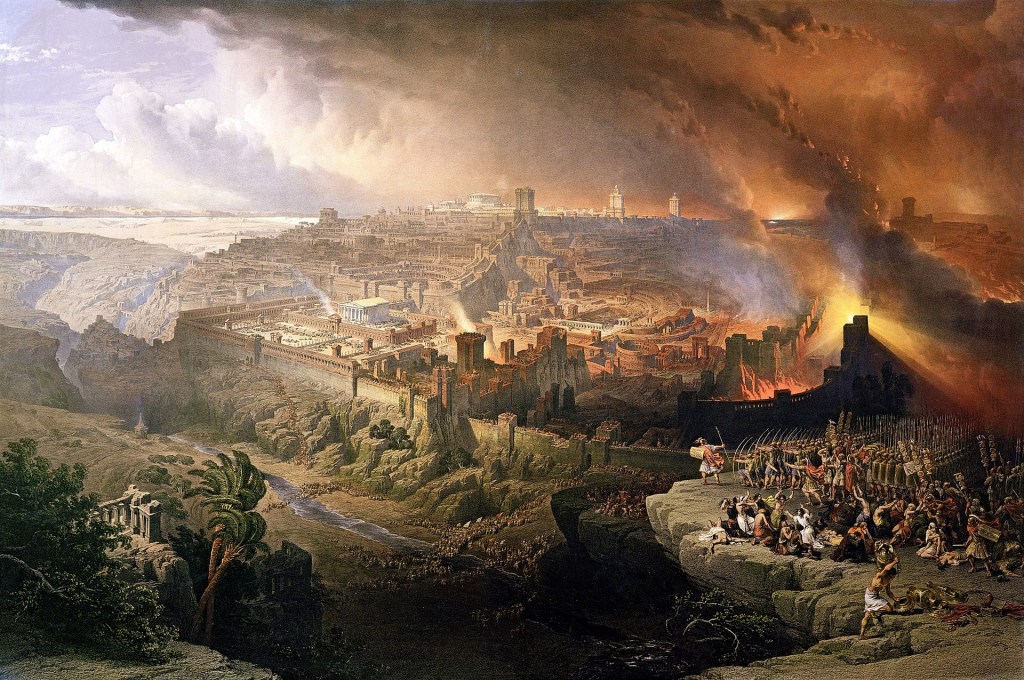
But the questions that ought to be asked are these: “What is the context (surrounding content) of the statement by the apostle Paul here? Does irrevocable mean without exception to anything that God has stated?” “Are the land promises given to Abraham, Isaac, and Jacob’s descendants of the same caliber and category to which is being referenced in Romans 11?” Meaning, “Were the promises of the land unconditional, or did God put a condition on them?” “Were those promises left unfulfilled, or did God fulfill them?” “If they were fulfilled, then on what grounds can one claim that Israel being brought back to that area of the world in the 1940-50’s is a fulfillment of Bible prophecy; what specific prophecy is being referenced?” “What does this say about the promises of God if Israel were not in the land for nearly 1900 years after their expulsion as a nation during the era of the Roman Empire in 70A.D.?” And one final question that needs to be thought out, but it will not be a key focus for us today surrounds the supposition that we are required to protect modern-day Israel from their enemies? “Do we have a sovereign right, provided by the Lord our God to enter into the conflicts of another nation when they are attacked? For many Zionists in our nation force this line of thought upon us without any cogent2 argument for it.
As Christians it is our duty to investigate every argument presented, and not just accept them at face value.3 Arguments are like buildings or structures, they are only as effective as the foundation upon which they are built. That which is built on shifting sand is a false foundation, whereas that which is built on solid rock is a true foundation. This our God teaches us in His Word. And if we are to know the foundation of the argument to which we seek we must learn where to turn to first in order to test that which is being spoken. As R. J. Rushdoony aptly stated,
“Every fact is a God-created and God-interpreted fact, and this world exists only as a God-created and God-interpreted world… [Thus] the only true interpretation of any fact, including man, is in terms therefore of God the Creator and providential Controller… [Unfortunately,] Christian thought has consistently gone astray, throughout most of its history, by seeking to answer the world in terms of the world’s own categories.”4
What I would like to do today is offer a brief exercise in investigative biblical study.5 According to our Lord, the truth is found in no other place than God’s Word.6 Meaning, the foundation and interpretive grid or corrective lens by which we need to see and analyze the world around us. Succinctly put,
“Sanctify them in truth; Your word is truth” (John 17.17).
The Land Promise…
In the book of Genesis we see that God promised the land to the descendants of Abraham, Isaac, and Jacob about six different times. The first and most prominent passage is recorded for us in Genesis 15:18 (cf. vv. 7-8) where it is written,
“To your descendants I have given this land, From the river of Egypt as far as the great river, the river Euphrates.”
This did God solemnly swear in terms of a covenant promise (Gen 15.17).
Concerning the Type of Promise…
Now we know that God promised Abraham, and his sons after him, to do this very thing. It would come about after a period of wandering and servitude to foreign powers. However, once the time was complete the descendants of these fathers (Abraham, Isaac, and Jacob; aka., Israel) would inherit the land from the Lord.
The question that we should consider at this point is related to the promise itself. Is it conditional or unconditional? Conditional means that there are limitations placed upon the promise; whereas unconditional means that there are no limitations placed upon the promise because the promise is irrevocable. This brings us back to what Paul spoke of in Romans 11:29. Does the land promise fall under the designation of an irrevocable, and thereby unconditional, promise? It is often assumed that it does, but we should never make assumptions on matters that another has determined. Especially, when that other is God who we’ve been commanded not to take His Name in vain.
1st comes the covenant…
Exodus 19:4-6—
“‘You yourselves have seen what I did to the Egyptians, and how I bore you on eagles’ wings, and brought you to Myself. Now then, if you will indeed obey My voice and keep My covenant, then you shall be My own possession among all the peoples, for all the earth is Mine; and you shall be to Me a kingdom of priests and a holy nation.’ These are the words that you shall speak to the sons of Israel.”
Based off the covenantal structure provided in God’s Word we see that the terms of the agreement are conditional represented by the formula “If….then.” If you do this, then I will do this. If you are faithful, then I will do this. God blesses faithfulness, not faithlessness. If He blessed the latter, then there would be no fear of hell, which is the eternal consequence of faithlessness.
In order for Israel to experience the blessings of God they needed to remain faithful. They need to listen to His voice and obey His commands, then they would be a special people, a distinct people, a holy people, a kingdom of priests unto the Lord and His creation. But does this conditional covenant just apply to personal salvation or to the land promise as well? It is all or nothing with God. His blesses the faithful in every area of life, but He curses the faithless in every area of life.
Blessings and Curses…
“Now it shall be, if you diligently obey the LORD your God, being careful to do all His commandments which I command you today, the LORD your God will set you high above all the nations of the earth. All these blessings will come upon you and overtake you if you obey the LORD your God” (Deuteronomy 28.1-2; cf. Lev 26.3).
“But it shall come about, if you do not obey the LORD your God, to observe to do all His commandments and His statutes with which I charge you today, that all these curses will come upon you and overtake you” (Deuteronomy 28.15; cf. Lev 26.14).
The list of blessings and curses applies to every area of life. It applies personally, in the home, in workplace, in terms of wealth and produce, to the mental state of the individual in question, and their standing among their neighbors (domestic or otherwise). The importance of this truth cannot be overlooked for God reiterates this truth several times in His Word through Moses His servant (see ref. above). Now, did this apply to the land promise specifically?
The Conditional Land Promise…
First off, let us start with who truly owns the land? It is said that the land is Israel’s today for it was given to them in the past. What sort of giving was it? Was it a lease on the land conditioned on the faithfulness of the people in question, or was it given permanently to them no matter what? According to Leviticus 25:23,
“The land is Mine; for you are but aliens and sojourners with Me.”
Moreover, the stipulations on living in the land is based on covenantal faithfulness. For God warned Israel:
“‘Do not defile yourselves by any of these things; for by all these the nations which I am casting out before you have become defiled. For the land has become defiled, therefore I have brought its punishment upon it, so the land has spewed out its inhabitants. But as for you, you are to keep My statutes and My judgments and shall not do any of these abominations, neither the native, nor the alien who sojourns among you (for the men of the land who have been before you have done all these abominations, and the land has become defiled); so that the land will not spew you out, should you defile it, as it has spewed out the nation which has been before you. For whoever does any of these abominations, those persons who do so shall be cut off from among their people. Thus you are to keep My charge, that you do not practice any of the abominable customs which have been practiced before you, so as not to defile yourselves with them; I am the LORD your God’” (Leviticus 18.24-30).
“Then the LORD spoke to Moses in the plains of Moab by the Jordan opposite Jericho, saying, “Speak to the sons of Israel and say to them, ‘When you cross over the Jordan into the land of Canaan, then you shall drive out all the inhabitants of the land from before you, and destroy all their figured stones, and destroy all their molten images and demolish all their high places; and you shall take possession of the land and live in it, for I have given the land to you to possess it. You shall inherit the land by lot according to your families; to the larger you shall give more inheritance, and to the smaller you shall give less inheritance. Wherever the lot falls to anyone, that shall be his. You shall inherit according to the tribes of your fathers. But if you do not drive out the inhabitants of the land from before you, then it shall come about that those whom you let remain of them will become as pricks in your eyes and as thorns in your sides, and they will trouble you in the land in which you live. And as I plan to do to them, so I will do to you’”(Numbers 33.50-56; emphasis mine).
These promises were reiterated by the prophets when Israel was condemned and carried off into captivity. First, it was the Assyrians that took the Northern Kingdom of Israel (after the splitting of the nation with the passing of Solomon). Second, it was the Babylonians that took the Southern Kingdom of Judah for their faithlessness. But God promised to bring His people back and after 70 years he did just that in fulfillment of what He said. The next and final removal from the land would occur after the desolation promised by Daniel the prophet (Dan 9.24-27) with the ushering in of the Messianic Age to which we are still in. The desolation promised would result in the destruction of the city, of the temple, and the giving of the promises—including the entire earth—to those deemed worthy of it. A prophetic outcome finalized in the year 70A.D.
The Prophetic Parable of our Lord…
“And He began to tell the people this parable: ‘A man planted a vineyard and rented it out to vine-growers, and went on a journey for a long time. At the harvest time he sent a slave to the vine-growers, so that they would give him some of the produce of the vineyard; but the vine-growers beat him and sent him away empty-handed. And he proceeded to send another slave; and they beat him also and treated him shamefully and sent him away empty-handed. And he proceeded to send a third; and this one also they wounded and cast out. The owner of the vineyard said, ‘What shall I do? I will send my beloved son; perhaps they will respect him.’ But when the vine-growers saw him, they reasoned with one another, saying, ‘This is the heir; let us kill him so that the inheritance will be ours.’ So they threw him out of the vineyard and killed him. What, then, will the owner of the vineyard do to them? He will come and destroy these vine-growers and will give the vineyard to others.” When they heard it, they said, “May it never be!” But Jesus looked at them and said, “What then is this that is written: ‘The stone which the builders rejected, This became the chief corner stone’? Everyone who falls on that stone will be broken to pieces; but on whomever it falls, it will scatter him like dust’” (Luke 20.9-18; emphasis added; cf. Matt 21.33-46; Mark 12.1-12; also see: Psa 80.8-14; Isa 5.1-7; Jer 2.21; John 15.1-8).
Who are the others who are promised the vineyard that God had planted? They are the faithful ones under Jesus Christ our Lord and Savior. After this final rebellion by Israel, the land was made desolate, the promise void. Some don’t like that claim because they say that the land promise was never truly filled in its entirety. Is that true? Well, what does the Lord our God have to say about the matter?
Promises fulfilled…
“So the LORD gave Israel all the land which He had sworn to give to their fathers, and they possessed it and lived in it. And the LORD gave them rest on every side, according to all that He had sworn to their fathers, and no one of all their enemies stood before them; the LORD gave all their enemies into their hand. Not one of the good promises which the LORD had made to the house of Israel failed; all came to pass” (Josh 21.43-45; emphasis mine).
This declaration was at the beginning of receiving their inheritance. A time when the conquest of Canaan was well developed, although not finalized. According to God’s prophet, the Lord God fulfilled every one of His promises. A Spirit filled testimony of the faithfulness of God in response to the faithfulness of His people. But we are not yet finished. There is one more passage to look at, and it is at the height of Israel’s dynastic past as God’s representative people. For before Solomon fell into sin, he glorified God with his whole heart and God blessed him for it. As we see in 1Kings 4:20-25,
“Judah and Israel were as numerous as the sand that is on the seashore in abundance; they were eating and drinking and rejoicing. Now Solomon ruled over all the kingdoms from the River to the land of the Philistines and to the border of Egypt; they brought tribute and served Solomon all the days of his life. Solomon’s provision for one day was thirty kors of fine flour and sixty kors of meal, ten fat oxen, twenty pasture-fed oxen, a hundred sheep besides deer, gazelles, roebucks, and fattened fowl. For he had dominion over everything west of the River, from Tiphsah even to Gaza, over all the kings west of the River; and he had peace on all sides around about him. So Judah and Israel lived in safety, every man under his vine and his fig tree, from Dan even to Beersheba, all the days of Solomon” (I Kings 4.20-25).
Closing Remarks…
What then are we to conclude about the land promises given to Abraham, Isaac, and Jacob’s descendants? Are they fulfilled? Yes, according to the Holy Spirit’s testimony they are. Were they conditional? Yes, according to the Holy Spirit’s testimony they are. What then is the basis for the argument today? According to Jesus, the day was fast approaching when what Israel possessed was going to be ripped from them and given to tenants who would be faithful. The meek would inherit the earth, not just some small patch of earth in the Middle East. The land promise does not fall under the category of an irrevocable promise in the sense that it is timeless, but as far as the Lord is concerned He did not revoke the promises He gave to His servants Abraham, Isaac, and Jacob. Israel had been blessed to be more numerous than the sands on the seashore. They had inherited everything God promised they would, as far the eye could see. But unlike salvation or God’s saving/elective grace, the land promises were conditionally based. Obedience God blesses, but the disobedient God curses.
I would encourage any who is interested to study this matter in greater detail. Perhaps, I missed something. As hot of a topic as it is within Christian circles we can hardly say it is a matter that isn’t worth our study. We should study and be well prepared in order to lovingly correct our brethren and graciously teach those willing to learn.
ENDNOTES:
1The term “axiomatic” means “evident without proof or argument.”
2The term “cogent” means “powerfully persuasive.” Our arguments need to be well thought out and articulated to our audience; especially, if we sit in a position of authority where a greater burden is placed upon the speaker who stands accountable. To call a people to war or to defend their active involvement in a war surely fits under this designation.
3Cf. Proverbs 18:17; 1Thessalonians 5:21; Acts 17:11. All three of these passages deal with testing the argument presented. A responsibility that takes times and effort, and in some circumstances makes a person feel uncomfortable. But is nonetheless what the man or woman of God is called to do.
4R. J. Rushdoony, By What Standard: An Analysis of the Philosophy of Cornelius Van Til, Reprint 1958 (Vallecito, CA: Ross House Books, 1995), 23, 9, 3 (respectively).
5I borrowed this phrase and reworked it from the original “investigative journalism.”
6Cf. John 8:31-32; Also see Proverbs 1:7; 9:10; Colossians 2:3.
 Kristafal's Musings